
Non-Alcoholic, De-alcoholized, and Low-Alcohol, What I Finally Understand
I got curious.
I noticed three terms showing up on bottles: non-alcoholic, de-alcoholized, and low-alcohol. For a long time, I treated “non-alcoholic” and “de-alcoholized” like they were the same thing. Interchangeable. I thought they were just two ways of saying, “no alcohol.” Then I realized they are different categories. They suggest different starting points. They also suggest different results in the glass.
So I did what I always do when something does not make sense. I looked it up. I read the words on the bottle. Then I connected those words to what I actually taste.
This post is the summary I wish I had on day one.
The three terms, defined in plain language
Non-alcoholic
Non-alcoholic is the broad umbrella term.
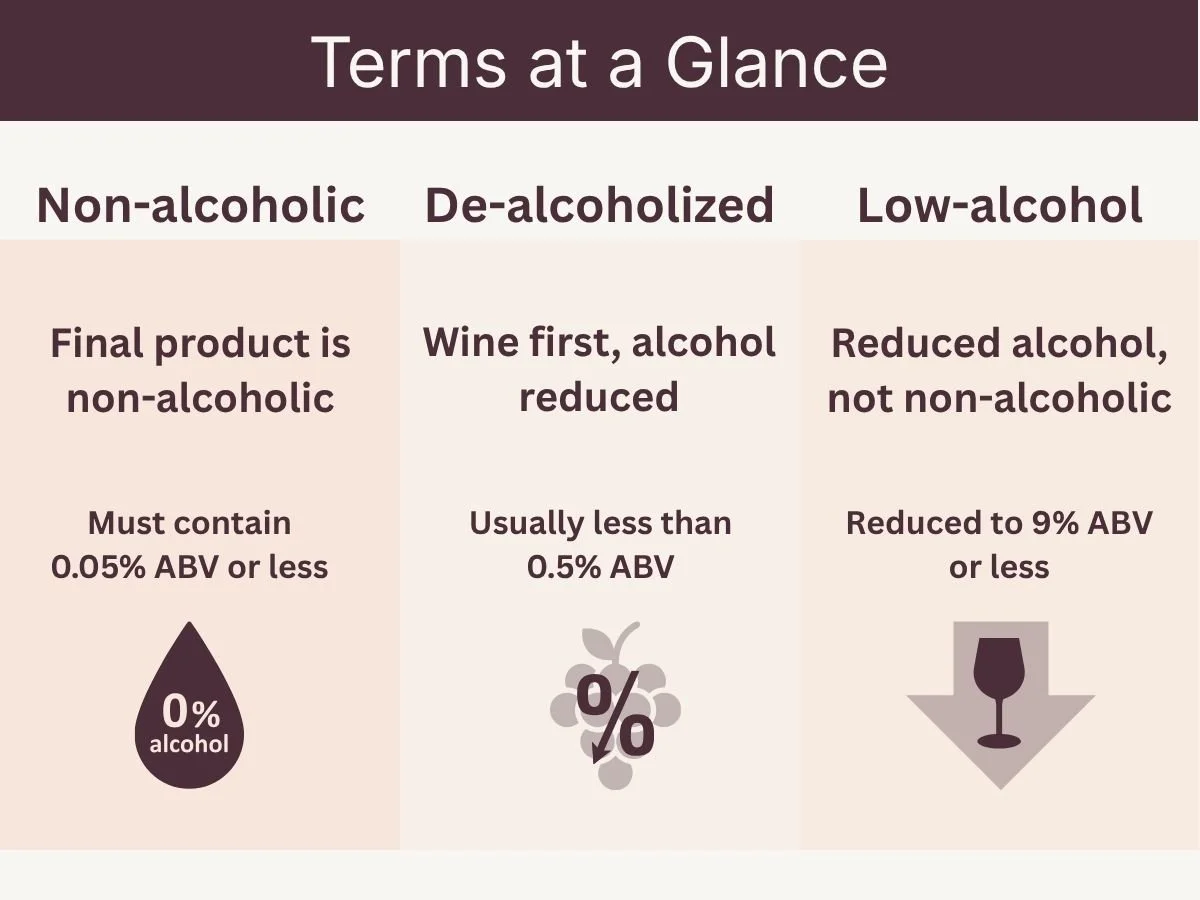
It tells you the final product is a drink that is considered to be non-alcoholic. You may see alcohol ranges like 0.0% alcohol or less than 0.5% alcohol on labels, depending on local rules.
What it does not automatically tell you is how the producer made it.
In practice, non-alcoholic wine can include:
1) de-alcoholized wine
2) other styles of non-alcoholic drinks, some that are made to mimic the flavour of wine.
De-alcoholized
De-alcoholized is a method term.
It usually means the producer made a traditional fermented wine first, then lowered the alcohol later.
That one detail matters for two reasons.
1) It helps explain why some de-alcoholized bottles taste more like wine.
2) It helps explain why two bottles that say “de-alcoholized” can still taste different. Different producers can start with different wines and reduce the alcohol in different ways, so the final result is not always the same.
Low-alcohol
Low-alcohol is the middle category.
Regular wine typically contains 12% to 15% ABV (alcohol by volume). In contrast, reduced-alcohol or low-alcohol wine generally falls between 5.5% and 11% ABV. The alcohol is reduced, but it is not in the non-alcoholic range. There is still enough alcohol to have the effects of intoxication. In other words, low-alcohol is not the “no alcohol” category.
How producers lower alcohol, in simple terms
De-alcoholized wine starts as a traditionally fermented wine. The alcohol is reduced later so that the final product lands in the non-alcoholic threshold.
The “non-alcoholic” umbrella can include de-alcoholized wine, but it can also include other formulations that aim to mimic the character of wine.
Low-alcohol means the alcohol reduction does not go far enough to land in the non-alcoholic range.
The industry uses different methods to reduce alcohol after fermentation. Some approaches rely on physical steps that separate alcohol from the wine. The key point for you is this. The alcohol reduction step can change the wine. Even when the flavour is still there, you should expect a slightly different experience.
What it can mean for taste in your glass
De-alcoholized tasting expectations
Because the base starts with full fermentation, de-alcoholized options usually retain more of the wine experience. The alcohol is gone, so the drink can feel and taste lighter than regular wine. But you are more likely to recognize the wine character you are used to.
Non-alcoholic tasting expectations
Because non-alcoholic is broader, the taste can range widely. When non-alcoholic products lean toward formulations that do not go through the same full fermentation path, they can taste much closer to sweet grape juice, sometimes with added ingredients that mimic a wine-like feel. That is not automatically bad. It is simply a different goal.
That is why two bottles can both be labelled non-alcoholic and still taste nothing alike.
Where craft producers fit in, and why I am planning to try them
As I learned more, I found mentions of producers who aim for the “essence of wine” without starting from fermented wine in the usual way. These products often use ingredients like tea and fruit juices to build flavour.
I have not tried one yet. I want to. I plan to, because it is a different approach. If I truly care about enjoying wine with food and as a social ritual, I need to understand how those products perform in real life, not just in theory.
That is one of the fun parts of this journey. The world keeps expanding, and more options show up than I expected.
ABV, what it stands for, and what it means for you
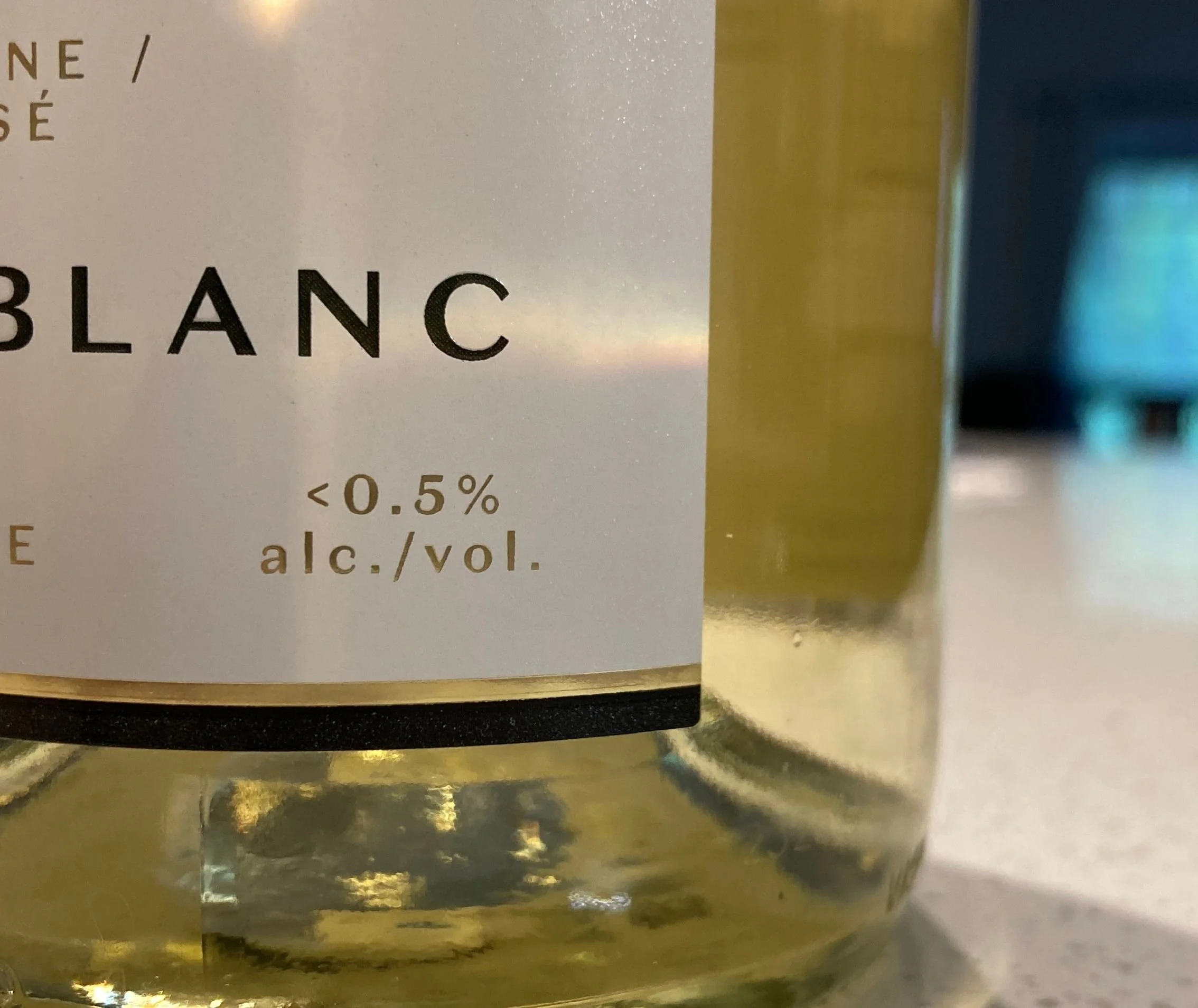
<0.5% alc./vol. = less than 0.5% ABV
ABV stands for Alcohol By Volume. It tells you how much alcohol is in the drink. In simple terms, it helps you understand how close the bottle is to being non-alcoholic.
De-alcoholized: 0.0% to under 1.1% ABV (with the alcohol physically removed). The goal is a non-intoxicating wine product.
Non-alcoholic/Alcohol-free: Must contain 0.05% ABV or less. Non-alcoholic tells you the alcohol level in the final product, not how the product was made.
Low-alcohol/light: Refers to beverages that have been formulated or reduced to 9% or less ABV.
Higher than the non-alcoholic range. If your goal is to avoid alcohol effects, you likely need to skip this category
Alcohol Declaration Rule: In Canada, any beverage containing 1.1% or more ABV legally requires the exact percentage to be declared on the principal display panel.
What I look for on a label now
Once I learned the terms, I stopped guessing.
Now when I shop, I look for three specific things:
The category label: Non-alcoholic, de-alcoholized, or low-alcohol.
The exact ABV: I check for numbers like 0.0% or "less than 0.5%."
The personal fit: I make sure the drink safely aligns with my own boundaries.
Once a bottle checks those boxes, I approach it with one key mindset shift.
If a label says "de-alcoholized," I expect a taste closer to traditional wine because it likely started as a real, fermented vintage before the alcohol was removed. However, I also accept that the dealcoholization process alters the final product. I try not to judge the bottle for what it isn't. Instead, I appreciate it for what it is.
My skip-it rule, and why it saves me disappointment
Here is the part that made shopping feel simpler.
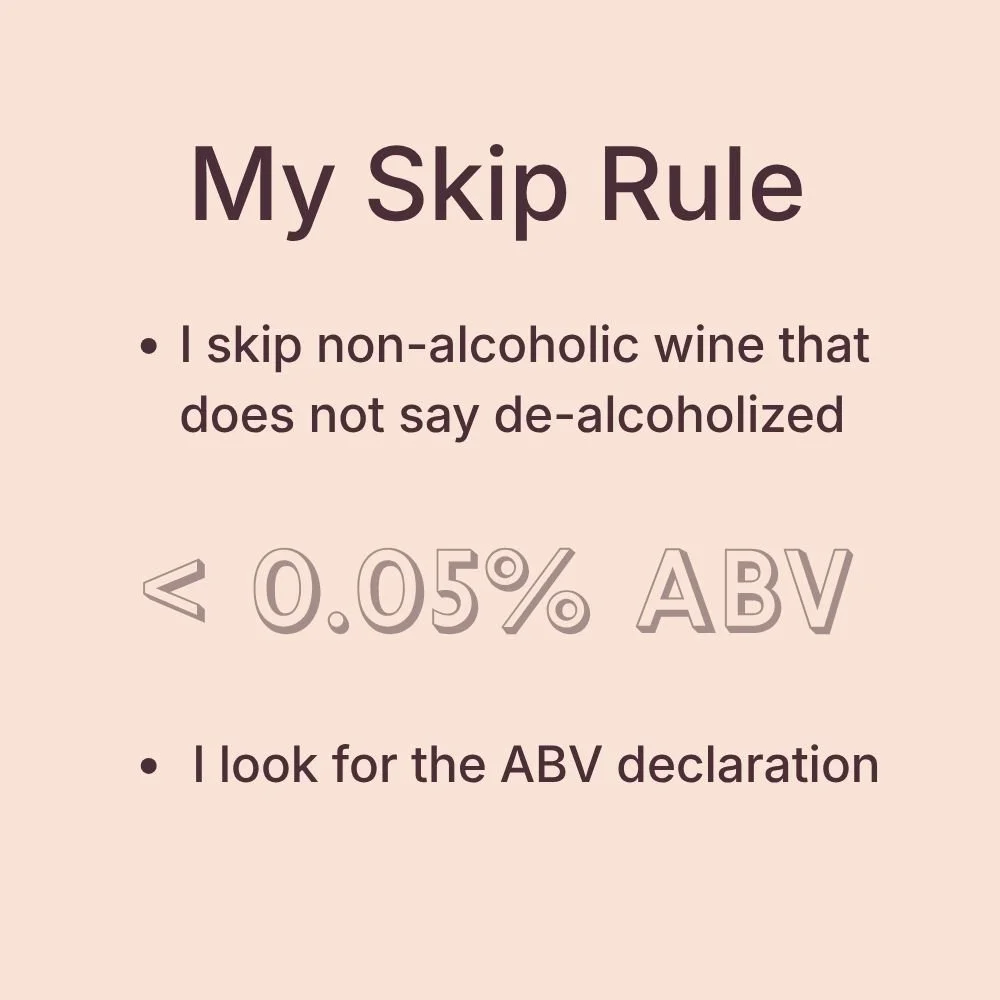
I skip non-alcoholic products that do not say de-alcoholized.
My reason is straightforward.
If it is non-alcoholic but not de-alcoholized, I cannot assume it started as real wine.
If it did not start from fermented wine, it is more likely to lean sweeter and closer to sweet grape juice styles.
That is usually not what I want when I am shopping for wine with food and social enjoyment.
This is why I do not just want “non-alcoholic.” I want “the closest version to the wine ritual I love.”
When friends invite me for dinner, I would not bring grape juice. I want to bring something that smells, tastes and feels like wine, or as close as possible to the real thing.
What 0.5% ABV really feels like, compared to food you already eat
One thing I did not expect to learn is how small 0.5% is in the bigger picture.
An ABV around 0.5% is still low. It is in the same general zone as many fruit juice-like drinks. It is also in a zone that overlaps with foods where small alcohol-like components can show up naturally.
I am not claiming equivalence, but the practical takeaway for me was this. Around 0.5% ABV is no longer the “I am drinking alcohol” category for most people. It is more like the kinds of levels you see in certain fermented condiments, yeast breads, and foods like ripe bananas.
That helped me set my own expectations.
I avoid low-alcohol products because I have my own reason to avoid alcohol. But I treat 0.5% and below as the range where I can focus on taste and routine without feeling like I am breaking my own rules.
Where I am now
This discovery has opened up many other questions for me. It also made the whole category feel less confusing.
The world of NA wine keeps expanding. I keep learning how the labels work and what they can signal. Some non-alcoholic wines are de-alcoholized. Some products are made using different starting points and formulation choices. Even when the bottles look similar at first glance, the routes can be different.
If you are also learning, here is my encouragement.
The label words are not random. They are clues. And the more you understand the clues, the less you have to rely on blind hoping.
That is where I am now. Learning, adjusting, and building a life where the ritual stays, and alcohol does not.